Fire sprinkler regulations depend on where the property is located, how the building is used, whether it is new or existing, and what type of building work is being carried out.
The requirements for a new home in Wales are not the same as the requirements for an existing shop in England. A care home, house in multiple occupation, block of flats, office, warehouse and domestic house can all involve different approval routes and technical standards.
Penguin Cooling provides fire sprinkler design and installation for homes and businesses across South Wales, Bristol and surrounding areas. We can help you discuss the system requirements for a new build, conversion, extension, loft conversion or commercial project. Call or WhatsApp 07426 225517, or contact Penguin Cooling to discuss your property.
Are Fire Sprinklers Required by Law in the UK?
There is no single UK-wide rule saying that every building must have a fire sprinkler system. Fire sprinkler requirements come from a combination of building regulations, fire-safety legislation, approved guidance, the building’s use, the project scope and sometimes the insurer or fire strategy.
In simple terms, a sprinkler system may be required because:
•The building is new or is being converted.
•The building has a residential, care or sleeping risk.
•The building is a house in multiple occupation or a block of flats.
•A change of use affects fire safety provisions.
•An extension, loft conversion or material alteration affects the protected areas.
•The project uses sprinklers as part of an approved fire-safety strategy.
•An insurer, landlord, funder, fire engineer or local authority requires additional protection.
•The property is a commercial or higher-risk building where a specific design standard applies.
A fire risk assessment and a building-control discussion may be needed before a final decision is made. The fact that sprinklers are not automatically required in every existing property does not mean they can be omitted from a project where the building regulations, fire strategy or approval conditions require them.
Fire Sprinkler Regulations in Wales
Wales has a specific regulatory history for automatic fire suppression systems in residential premises. The Welsh Government explains that the Domestic Fire Safety (Wales) Measure 2011 led to a mandatory requirement for automatic fire suppression systems in new residential premises, implemented through the Building Regulations.
The Welsh Approved Document B guidance explains that Regulation 37A introduced the requirement for automatic fire suppression systems in relevant new residential premises in Wales. The guidance refers to new premises in several residential purpose groups and identifies exceptions and special cases, so the exact building classification matters.
The Welsh householder guide also confirms that new and converted homes in Wales may need an automatic fire suppression system. It explains that the house builder or sprinkler installer should provide information about the system so the homeowner can understand and maintain it. The guide itself is advisory and does not replace the regulations or project-specific approval.
New homes in Wales
A new home in Wales should be reviewed against the current Welsh Building Regulations and the relevant Approved Document B guidance. The system normally needs to be considered at design stage because the water supply, tank, pump, pipe routes, sprinkler coverage, ceiling construction and access requirements can affect the building layout.
The sprinkler design should not be left until the end of construction. Late changes can create problems with concealed pipework, pump and tank locations, ceiling finishes, electrical supplies and inspection access.
Converted homes in Wales
Conversions can include changes to an existing building that create residential accommodation or change the use of an existing property. A conversion may require automatic fire suppression even where the original building did not have sprinklers.
The legal position depends on the type of conversion, the purpose group, the material change of use and the building work involved. A conversion should be discussed with Building Control and the design team before work begins.
Extensions and loft conversions in Wales
An extension, conservatory or loft conversion can affect sprinkler coverage and the building’s fire-safety strategy. The Welsh Government householder guide explains that an extension or loft conversion should maintain the same level of sprinkler protection as the rest of the home and may require the sprinkler system to be extended.
A new partition can also affect the way a sprinkler system protects a room. Moving walls, lowering ceilings, changing a room’s use or installing large fixed obstructions can alter the assumptions behind the original design.
Care homes and children’s homes in Wales
The 2024 amendments apply to buildings and building work in Wales and explicitly include automatic fire suppression requirements for care homes for children. They also address certain changes of use between care homes for children and care homes for adults. Transitional arrangements can apply depending on when a building notice, initial notice or full plans were submitted.
Care-home projects should therefore be assessed using the current regulations, the building’s use, the relevant guidance, the care regulator’s expectations and the project’s fire strategy. Do not rely on an older sprinkler rule or a general domestic assumption.
HMOs and residential buildings in Wales
Houses in multiple occupation can involve additional fire-safety duties, licensing requirements and local authority conditions. Welsh Approved Document B guidance notes that HMO licensing is typically overseen by the local authority, which may require precautions above the baseline guidance.
A landlord or developer should confirm the building’s definition, number of residents, self-contained accommodation, licensing position and any local authority requirements before deciding the sprinkler scope.
Fire Sprinkler Regulations in England
England uses its own Building Regulations and Approved Document B framework. The current GOV.UK Approved Document B fire-safety page applies to England and provides separate volumes for dwellings and buildings other than dwellings.
Approved Document B is statutory guidance rather than a complete replacement for professional design. It describes ways of demonstrating compliance, but a project may use an alternative solution where it satisfies the functional requirements and is properly designed and approved.
Recent updates to Approved Document B include provisions for sprinklers in new care homes. The current guidance also includes updated provisions affecting certain blocks of flats, including changes to the height trigger referred to in the latest volumes. Because amendments and transitional arrangements can affect a project, the current edition should be checked at the time of design and approval.
New homes and flats in England
Sprinkler requirements for new homes and flats in England depend on the building type, height, layout, means of escape, fire strategy and the applicable edition of Approved Document B.
High-rise and multi-storey residential buildings may have different requirements from a traditional two-storey house. Flats, common areas, protected stairs, corridors and other residential arrangements need to be assessed as part of the whole building rather than by looking at a single room.
Care homes in England
The current Approved Document B updates include provision for sprinklers in new care homes. A care-home project should be reviewed against the current English guidance, the building’s use, the fire strategy and the relevant approval process.
Existing care homes, extensions and changes of use require a project-specific assessment. The correct answer may involve sprinklers, other fire-safety measures, a material change-of-use analysis or a combination of controls.
Commercial buildings in England
Offices, shops, restaurants, warehouses, factories and other commercial buildings are not all subject to the same sprinkler requirement. The need for sprinklers may arise from the building regulations, a fire-engineered solution, the hazard and storage arrangements, the insurer, the responsible person’s fire-risk assessment or the client’s fire strategy.
For a non-residential system, the design may need to consider water supplies, pumps, tanks, alarm valves, hazard classifications, storage heights, flow rates, zoning, monitoring and access for inspection and testing.
Building Regulations Versus Fire-Safety Regulations
These terms are related but they are not identical.
Building Regulations
Building Regulations generally control building work, construction, material changes of use and the design of new or altered buildings. They are normally dealt with through Building Control and the project’s design and approval documents.
Building Regulations can determine whether automatic fire suppression is required and what performance the system must achieve as part of the building design.
Fire-safety legislation
Fire-safety legislation applies to the ongoing management and use of many occupied premises. In England and Wales, the Regulatory Reform (Fire Safety) Order 2005 is an important legal framework for non-domestic premises.
The responsible person must assess fire risk and implement suitable fire precautions. The law does not mean that every business automatically needs sprinklers, but it does require the responsible person to manage the risks and maintain relevant fire-safety measures where they are provided or required.
The HSE explains that the responsible person should keep the fire-risk assessment up to date and ensure that work does not interfere with escape routes, fire separation, alarms, dry risers or sprinkler systems. The  HSE general fire-safety guidance is particularly relevant during construction and refurbishment.
Planning permission and Building Control
Planning permission, Building Regulations approval and fire-safety obligations are separate questions. A project may need one, two or all three routes, depending on the property and work.
A sprinkler installer can provide technical input, but the owner, designer and project team should confirm the approval route with the local authority and Building Control. A sprinkler quotation is not the same as Building Regulations approval.
Which Standard Applies to a Fire Sprinkler System?
The appropriate technical standard depends on the building and system. A standard is not automatically a law, but it may be referenced by building guidance, required by the project’s fire strategy, requested by an insurer or used to demonstrate suitable design and installation.
BS 9251:2021 for domestic and residential premises
 BS 9251:2021 is a code of practice for fire sprinkler systems in domestic and residential occupancies.
The BSI overview describes its scope as including:
•Residential repair and modification considerations
BS 9251:2021 replaced BS 9251:2014. It includes recommendations for taller residential buildings and higher-risk scenarios, including additional resilience considerations for certain systems.
A domestic system should not be designed by copying a commercial layout or choosing a sprinkler head from a catalogue without checking the system design, water supply and applicable standard.
BS EN 12845 for commercial systems
Commercial sprinkler projects may use BS EN 12845, subject to the building, hazard, system type and fire strategy. It is commonly associated with automatic sprinkler systems for non-residential applications and involves detailed requirements for water supplies, pumps, tanks, hazard classifications, pipework, valves, testing and maintenance.
A mixed-use building may use different standards for different parts of the property. The BSI description of BS 9251 notes that residential parts may be protected using BS 9251 while non-residential parts may be appropriate for BS EN 12845, depending on the circumstances.
The correct standard should be confirmed by the designer or fire engineer. It should not be selected only because it appears on a previous quotation.
BS 9252 and system components
Sprinkler components also need to be suitable for the system and relevant approval requirements. The Welsh Approved Document B guidance refers to appropriate technical standards for residential sprinkler components, including BS 9252 in the applicable guidance.
The head, valve, pipe, pump, tank, alarm and control equipment must work as part of the designed system. A component’s appearance or connection size alone does not confirm compatibility.
Fire Sprinkler Regulations for Different Property Types
Houses and new-build homes
The requirements depend on the jurisdiction and the project classification. In Wales, new residential premises are subject to the Welsh automatic fire suppression provisions. In England, the design should be checked against the current Approved Document B and the project’s fire strategy.
Flats and apartment buildings
Flats involve common areas, protected escape routes, risers, compartmentation, access and sometimes significant height. The sprinkler strategy should cover the building arrangement rather than only the inside of one flat.
HMOs
HMOs can involve licensing and fire-risk requirements in addition to Building Regulations. The local authority may require improvements beyond the basic guidance depending on the number of occupants, layout and risk profile.
Care homes and supported living
Care settings can house people who may need assistance to escape. New care homes have specific sprinkler provisions in current guidance, and changes between care-home uses may also be regulated. A care project should be handled as a specialist fire-safety design rather than treated as an ordinary domestic installation.
Offices, shops and restaurants
A commercial sprinkler requirement can be linked to the fire strategy, the hazard, occupancy, storage, insurance or the building regulations. Kitchens, cooking equipment, stock, customer areas and escape routes should be considered together.
Warehouses and industrial buildings
Warehouse and industrial systems can involve high-piled storage, rack arrangements, flammable materials, process hazards, large floor areas and complex water supplies. Changes in storage height or commodity can change the sprinkler design requirement.
Extensions, conversions and refurbishments
A refurbishment can affect fire compartmentation, escape routes and sprinkler coverage. An existing system may need to be extended, modified, protected during the works and re-tested before the area is occupied.
Fire Sprinkler Design Information and Approvals
A compliant project normally needs more than a drawing showing sprinkler-head positions. The design information may include:
•Property use and occupancy
•Building plans and sections
•Fire strategy and risk information
•Relevant jurisdiction and building regulations
•Applicable technical standard
•Sprinkler head type and spacing
•Pipework routes and sizes
•Tank and pump requirements
•Valve and alarm arrangements
•Electrical and monitoring requirements
•Access for testing and maintenance
•Commissioning and handover records
The final design should be coordinated with the architect, structural engineer, mechanical and electrical team, Building Control, fire engineer and other project stakeholders where required.
Fire Sprinkler Installation Requirements
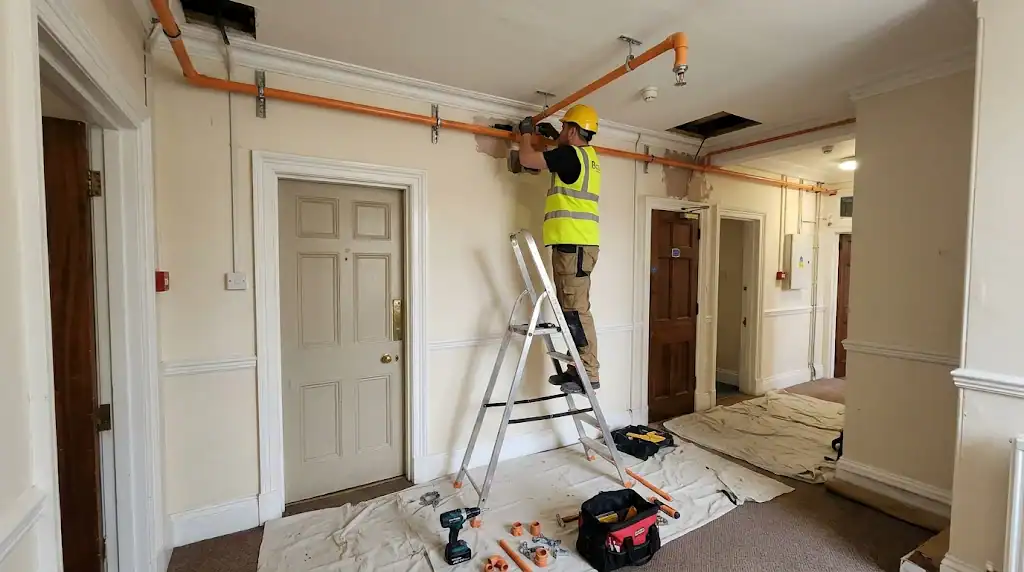
The installation must reflect the approved design and the selected standard. Work may involve concealed pipework, exposed pipework, sprinkler heads, control valves, tanks, pumps, alarms and test arrangements.
Important installation considerations include:
•Maintaining required sprinkler coverage
•Avoiding obstructions from beams, lights, ducts and ceiling features
•Protecting pipework from damage and freezing where relevant
•Providing suitable access to valves, pumps and tanks
•Coordinating with ceilings and finished surfaces
•Providing the required electrical supply and controls
•Protecting the system during construction
•Testing the water supply and alarm functions
•Recording changes made during installation
•Completing commissioning and handover information
Penguin Cooling provides Fire Sprinkler Installation for domestic and commercial requirements. The starting price shown for residential systems is from £1,500, but the final price depends on the number of sprinkler heads, water supply, property type, layout, access and project requirements.
Fire Sprinkler Maintenance and Regulations
A sprinkler system is a life-safety system, so it should not be treated as a one-time plumbing installation. The system needs planned inspection, testing and maintenance so that valves remain in the correct position, water supplies are available, alarms operate and visible damage is identified.
The Welsh Government householder guide recommends an annual maintenance check by a qualified fire sprinkler installer. It identifies checks including pump operation where a tank and pump are used, visual inspection for leaks, checking that the system has not been modified or obstructed, and checking that the sprinkler alarm remains effective.
The guide also recommends keeping written maintenance records. Records can help with future repairs, insurance claims, property sales and handover to a new owner.
What Happens if a Sprinkler System Is Altered?
A system should be reviewed if the building layout, use, ceiling, storage, water supply or protected area changes.
•Creating a new bedroom or office
•Dividing one room into two
•Adding a suspended ceiling
•Installing large ductwork or fixed storage
•Changing a shop or warehouse layout
•Changing a residential building into another use
•Replacing a pump, tank or water supply
•Removing or relocating sprinkler heads
In Wales, the householder guide explains that extensions and loft conversions may require the sprinkler system to be extended and that internal alterations should maintain the same level of protection. Welsh Approved Document B Volume 2 also explains that where an existing building already has an automatic fire suppression system, a material alteration should not leave the building less compliant and the system may need to be extended and re-certified for altered areas.
A system should not be altered by moving a sprinkler head to match a new ceiling without checking the design and approval requirements.
Fire Sprinkler Regulations and Insurance
Insurance requirements can be stricter or more specific than the minimum building regulations. A policy may require a particular design standard, approved components, inspection frequency, service report, impairment procedure or contractor competence evidence.
Before requesting a quotation, check whether the insurer requires:
•A specific sprinkler standard
•A third-party certification scheme
•Approved products or components
•Commissioning and test records
•A formal impairment notification
•A report after any activation or major repair
The British Automatic Fire Sprinkler Association explains the importance of competence, training and third-party certification in the sprinkler sector. Visit BAFSA for professional and technical information. An industry association page does not replace the building’s own design, approvals or insurer requirements.
Who Is Responsible for Fire Sprinkler Compliance?
Responsibility can be shared between the building owner, developer, landlord, employer, facilities manager, responsible person, designer, installer, tenant and other dutyholders.
The person responsible for the building should make sure that:
•The building’s fire-risk assessment is suitable and current.
•Fire-safety systems are maintained.
•Occupants and staff understand relevant procedures.
•Building work does not disable or obstruct protection.
•Defects and impairments are addressed.
•Contractors receive the information they need.
•Changes in use or layout are reviewed.
The exact legal duties depend on the property and jurisdiction. A sprinkler installer can provide technical information, but cannot transfer all building or fire-safety responsibilities away from the owner or responsible person.
Fire Sprinkler Compliance Documents
A well-managed system should have records that explain what was designed, installed, tested and maintained.
Useful documents may include:
•Hydraulic calculations where applicable
•Product and component information
•Pump and tank information
•Alteration and extension records
•Fire-risk assessment information
•Impairment and restoration records
The Welsh householder guide recommends leaving sprinkler information and maintenance records for a new owner when a property is sold. Keep the records accessible rather than storing them only with the original contractor.
Fire Sprinkler Regulations: Common Mistakes
Treating guidance as a universal rule
Approved Documents provide practical guidance, but the correct solution depends on the building and project. A sentence that applies to a new dwelling may not apply to an existing warehouse or a care setting.
Using an old standard without checking the current edition
BS 9251:2021 superseded BS 9251:2014. Older drawings and quotations should be checked against the current requirements and project scope.
Assuming a smoke alarm is a sprinkler alarm
Smoke alarms and sprinkler systems perform different functions. A sprinkler head responds to heat, while a smoke alarm detects smoke. The two systems should not be treated as interchangeable.
Forgetting about building alterations
An extension, loft conversion, ceiling change or new storage arrangement can affect the original design. The system should be reviewed before work starts.
Closing a sprinkler valve and forgetting to reopen it
The Welsh Government guide advises householders not to turn off the sprinkler stop valve. Where an authorised isolation is necessary, it needs to be controlled, recorded and restored.
Choosing a system by price alone
The lowest quote may not include design, water supply, testing, commissioning, records or the access required for future maintenance. Compare the complete scope rather than the number of sprinkler heads alone.
Assuming an installer’s quote is an approval
A quotation is a commercial document. It does not replace Building Control approval, a fire strategy, an insurer’s acceptance or the responsible person’s legal duties.
Fire Sprinkler Regulations FAQ
Are fire sprinklers compulsory in every UK home?
No. Requirements vary between Wales and England and depend on whether the property is new, converted or existing, its use, the building classification and the work being proposed. New and converted residential premises in Wales are subject to specific automatic fire suppression provisions. England uses its own Approved Document B framework.
Are sprinklers required in new homes in Wales?
Wales has a mandatory requirement for automatic fire suppression systems in relevant new residential premises under the Welsh Building Regulations framework. The exact scope and exceptions depend on the building type and purpose group. Confirm the current requirements with Building Control and the project design team.
Are fire sprinklers required in existing homes in Wales?
Not every existing home automatically needs a new sprinkler system. However, extensions, conversions, material changes of use and alterations can change the position. A project-specific assessment is needed.
Do loft conversions need sprinklers in Wales?
A loft conversion can affect the building’s protected accommodation and means of escape. The Welsh Government householder guide explains that a loft conversion may require the sprinkler system to be extended. Discuss the work with Building Control and a competent sprinkler designer before construction.
Are fire sprinklers required in care homes?
Care homes are subject to specific fire-safety and building-regulation considerations. Current England guidance includes provision for sprinklers in new care homes. Wales also has specific automatic fire suppression provisions, including the 2024 amendments covering care homes for children. Existing buildings and changes of use need separate assessment.
What is Regulation 37A in Wales?
Regulation 37A is the Welsh Building Regulations provision associated with automatic fire suppression systems in relevant residential and care-related building work. The application depends on the building type, use, project scope and the current regulations.
What is Approved Document B?
Approved Document B is government guidance for fire safety in building work. England and Wales publish their own guidance. It provides practical ways to meet the functional requirements, but the correct application depends on the project and may require professional design.
What standard is used for domestic fire sprinkler systems?
BS 9251:2021 is the current BSI code of practice for fire sprinkler systems in domestic and residential occupancies. It covers design, installation, components, water supplies, commissioning, maintenance and testing.
What standard is used for commercial sprinkler systems?
Commercial projects may use BS EN 12845 or another applicable standard depending on the property, hazard, system type and fire strategy. The correct standard should be confirmed by the project’s designer or fire engineer.
Do fire sprinkler systems need annual servicing?
The Welsh Government householder guide recommends an annual maintenance check by a qualified fire sprinkler installer for domestic systems. Commercial agreements can include more frequent inspections and testing depending on the system and requirements.
Can I paint over a sprinkler head or cover plate?
No. Paint, decoration or obstructions can interfere with the component and its operation. The system should be assessed by a competent person if a head or cover plate has been painted or damaged.
Can I turn off the sprinkler stop valve?
The stop valve should remain open so water can reach the sprinkler system. If an emergency or authorised repair requires isolation, the impairment should be controlled and the system restored as soon as possible.
Do fire sprinklers activate from smoke or cooking steam?
A sprinkler head is heat-operated. The Welsh Government guide explains that sprinklers are not activated by smoke, ordinary cooking heat, burnt toast or bathroom steam. A smoke alarm remains a separate and important part of fire safety.
Do all sprinkler heads activate at the same time?
Normally, only the head or heads exposed to sufficient heat near the fire operate. The Welsh Government guide explains that sprinklers in unaffected areas do not all activate like they are often shown in films.
Does BS 9251 apply to commercial buildings?
BS 9251 is for domestic and residential occupancies. A commercial or non-residential building may require BS EN 12845 or another standard. Mixed-use properties need a project-specific design.
Who approves a sprinkler system?
Building Control, the design team, the fire engineer, the insurer and other authorities may each have different roles. The appropriate approval route depends on the project. A sprinkler installer should coordinate with the project team but does not replace the statutory approval process.
Can Penguin Cooling help with fire sprinkler regulations?
Penguin Cooling can discuss fire sprinkler design and installation for domestic and commercial properties across South Wales, Bristol and surrounding areas. Send the property type, postcode, plans, intended use and project stage so the requirements can be considered.
Fire Sprinkler Regulations Support Across South Wales and Bristol
Penguin Cooling provides fire sprinkler services for homes, residential properties and selected businesses across:
•South Wales and selected surrounding areas